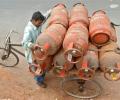
Researchers at CSIR-NCL have developed a technology for producing dimethyl ether (DME) as an alternative to liquefied petroleum gas (LPG), potentially reducing India's reliance on imports and enhancing energy security.

Israel and the United States had a plan. Iran punched back. And now the Gulf is reeling, the world is beginning to feel the pain and, as on date, no one in Washington or Tel Aviv appears willing to admit that the punch has landed, notes Prem Panicker, continuing his must-read blog on the war in the Middle East.

'America is adopting the typical 'my way or the highway'/'Either you are with us or against us' stance.' 'This is a policy India is not going to accept.'
Indian officials will visit the US to finalise the legal text for an interim trade agreement, expected to be signed in March, focusing on duty concessions and reciprocal tariffs.
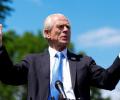
Using an expletive in his post on X, Navarro said, "Fact: India didn't buy Russian oil in large quantities before Russia invaded Ukraine. It's blood money and people are dying."

US President Donald Trump announced a new global levy on imported items, resulting in a lower tariff rate for India, following a Supreme Court verdict against his previous sweeping tariffs.

The LPG squeeze on India's restaurant sector is the quotidian face of a deeper crisis.

Haryana Chief Minister Nayab Singh Saini has launched development projects worth 253 crore in Jind district, focusing on irrigation, infrastructure, health, and water supply.
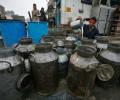
India has fully protected its sensitive sectors like dairy, rice, wheat, pulses, tea, genetically modified (GM) goods, and coffee by not granting any import duty concessions to the European Union (EU) under the bilateral free trade agreement, according to the Commerce Ministry.

Alliances fight wars effectively only when they share an endgame. If Israel acted without US knowledge, then the military alliance is operating without real coordination at the level of strategic targeting. Neither picture is reassuring in a war that is no longer regional in its consequences. Prem Panicker continues his must read daily blog on the Gulf War.

In a major setback to Trump's pivotal economic agenda for his second term, the US Supreme Court, in a 6-3 verdict written by Chief Justice John Roberts, ruled that the tariffs imposed by the president on nations around the world were illegal.
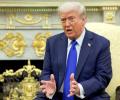
The US Representative criticised the administration's new USD 100,000 fee on H-1B visas, observing that Indians hold 70 per cent of these visas and saying the change directly harms workers who have long supported US innovation across technology, science and medicine.

The ruling is expected to have wide-ranging consequences for global trade, businesses, consumers, inflation trends and household finances across the country.

India has stated it will wait for the outcome of the elections in Bangladesh and the resulting mandate before addressing any existing issues. The country also affirmed its support for free, fair, inclusive, and credible elections in Bangladesh.

Taking Kharg would give the US control over virtually all of Iran's oil exports and thus provide significant leverage, notes Prem Panicker in his must read daily blog on the Gulf War. It would also put American troops within range of Iran's remaining missiles, drones, and artillery on a piece of real estate that is just eight square miles in size, and just 15 miles from the Iranian mainland.

Formula One has cancelled the Bahrain and Saudi Arabian Grands Prix scheduled for April due to escalating Middle East tensions, reducing the 2026 F1 calendar from 24 to 22 races.

United States President Donald Trump has said Prime Minister Narendra Modi 'knew he was not happy' with India's purchases of Russian oil and that Washington, DC can raise tariffs on New Delhi 'very quickly'.

India and the US have decided to reschedule their meeting to finalize the interim trade pact due to recent developments and implications, including changes in US tariffs.

'Strikes into the Gulf countries are proof that the security guarantees offered by the US are ineffective and that the Gulf countries cannot rely on American security assurances for their safety.'

After the US Supreme Court struck down President Donald Trump's global tariffs, Congress leader Rahul Gandhi accused Prime Minister Narendra Modi of being "compromised", saying his "betrayal" in the India-US interim trade deal stood exposed.

The pause gives the US time to breathe, to regroup, to move its expeditionary force into position without risk of interception along the way. It gives Iran nothing -- on the ground, attacks against its infrastructure continue apace. Prem Panicker in his must read daily blog on the Gulf War.

On World Health Day 2026, discover plants that improve health naturally, boost immunity, purify air and enhance well-being. Do read the simple gardening tips as well.

The rupee witnessed a volatile trading session and settled for the day on a slightly lower note, down 1 paisa at 90.66 against the US dollar on Monday, as traders assessed the details of the India-US interim trade framework.

In view of the disruptive situations, the Central government has also announced a financial relief package of Rs 497 crores aimed at helping exporters affected by disruptions in West Asia.

India and the US are expected to sign the first phase of a bilateral trade agreement by mid-March, which will result in the US lowering import duties on Indian goods. India will then begin reducing import duties on certain US goods.
India and the US are expected to sign the first phase of a bilateral trade agreement by mid-March, which will result in the US lowering import duties on Indian goods. India will then begin reducing import duties on certain US goods.

Prime Minister Narendra Modi spoke with Iranian President Masoud Pezeshkian to discuss the escalating tensions in West Asia, emphasising the safety of Indian nationals and the need for regional stability through dialogue and diplomacy.

India, China and other countries that have been cutting their oil imports from Iran have reached a point where it is "very very difficult" to reduce any further without seriously impacting their economies, US Secretary of State John Kerry has told lawmakers.

While investors would focus on the results and guidance for the third quarter of financial year 2025-26 (Q3FY26) in the normal course of business, the US-Israeli attack on Iran and the latter's retaliation at Gulf allies of the US has forced them to weigh the consequences of the event.

India has rejected White House Trade advisor Peter Navarro's comments on New Delhi for its procurement of Russian crude oil, calling them 'inaccurate and misleading'. The relations between New Delhi and Washington are on a downturn after President Donald Trump doubled tariffs on Indian goods.

India has completely protected the interests of its agriculture and dairy sector in the India-US trade agreement.

Following a Supreme Court setback, Donald Trump has announced an increase in global tariffs from 10% to 15%, impacting international trade relations and raising concerns about economic repercussions.
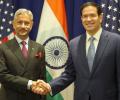
US Secretary of State Marco Rubio has said that the Trump administration hopes it can fix the "measures" it has taken with regard to India for its purchases of Russian oil.

However, copious oil supplies amid growing global output and slowing Chinese oil consumption will put India in a better bargaining position with Gulf suppliers.

As many as 17 cancer drugs, along with medicines and food for special medical needs for seven rare diseases, components for microwave ovens are some of the items that are set to become cheaper with Finance Minister Nirmala Sitharaman announcing cuts in customs duty in the Union Budget 2026-27.

In the wake of the FTA between India and the European Union, the United States has described the Europeans as 'very disappointing', saying they were unwilling to join Washington, DC in putting tariffs on New Delhi for its purchases of Russian oil because of this trade deal.

Russia's state-owned oil firm Rosneft has agreed to supply up to 500,000 barrels per day (bpd) of crude oil to Indian upstream oil and gas major Reliance Industries (RIL) in the largest-ever energy deal between the two countries, Reuters reported on Thursday. The 10-year agreement amounts to 0.5 per cent of global oil supply and is valued at roughly $13 billion per year at current prices, it said.
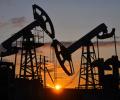
In a strategic move to boost offshore energy exploration and operational efficiency, Oil and Natural Gas Corporation Ltd (ONGC) and Reliance Industries Ltd have signed an agreement to share resources such as supply vessels used in finding and producing oil and gas.

India has protected the interest of domestic farmers and MSMEs by not extending any duty concessions on products across several sectors, including agricultural items such as dairy, as well as chocolates, gold, silver, jewellery, footwear, and sports goods, under the trade pact with Oman.

Inflation data, trading activity of foreign investors and global trends would dictate sentiment in the stock market this week, according to analysts.
